Radiology Innovators
Return To Radiology History Page
|
Max Theodor Felix Von Laue |
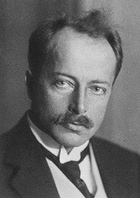
German recipient of the Nobel Prize for Physics in 1914 for his discovery of the diffraction of X rays in crystals. This enabled scientists to study the structure of crystals and hence marked the origin of solid-state physics, an important field in the development of modern electronics. Laue became professor of physics at the University of Zurich in 1912. Laue was the first to suggest the use of a crystal to act as a grating for the diffraction of X rays, showing that if a beam of X rays passed through a crystal, diffraction would take place and a pattern would be formed on a photographic plate placed at a right angle to the direction of the rays. The pattern would mark out the symmetrical arrangements of the atoms in the crystal. (See Laue diffraction pattern.) This was verified experimentally in 1912 by two of Laue's students working under his direction. This success demonstrated that X rays are electromagnetic radiations similar to light and also provided experimental proof that the atomic structure of crystals is a regularly repeating arrangement. Laue championed Albert Einstein's theory of relativity, did research on the quantum theory, the Compton effect (change of wavelength in light under certain conditions), and the disintegration of atoms. He became director of the Institute for Theoretical Physics at the University of Berlin in 1919 and director of the Max Planck Institute for Research in Physical Chemistry, Berlin, in 1951. |
Bibliography - Information from www.nobel-winners.com and used under the terms of the GNU Free Documentation License.
Radiology Student Zone
The Radiology Technician Student Zone - Find all the best radiology school resources at the student zone. Here we link to web sites, notes and tutorials that help you with a variety of medical imaging topics. Think of it as a radiology portal for imaging students.
Be sure to check out the radiology student community located at www.RadiologyForums.com where you will find discussions to help you with your learning experience.
How To Say Radiology School
[French- Radiologie écoles][German- Radiologie Schulen][Italian- Radiologia scuole]
[Spanish- Radiología escuelas]
[Mammography Schools] [MRI Schools] [Nuclear Medicine Schools] [Ultrasound Schools]
[radiology schools] [radiography schools] [radiography jobs] [financial aid] [radiology uniforms]
[Radiology Continuing Education]
Free Radiology School Info
Search for Radiology Schools - get a radiology degree online or on campus
Ultrasound Schools - click for a listing of ultrasound schools
Other Pages
Bone DensitometryCat Scan
Interventional
Echocardiology
Educators
Magnetic Resonance
Mammography
Management
Nuclear Medicine
PET Scan
Radiation Therapy
Radiography
Radiologist
Radiology PACS
Student Zone
Ultrasound
Good Links
Radiology SchoolsRadiology Videos
Radiology Articles
X-ray Links
Radiology AssociationRadiology Books
Radiology CME & CEU
Radiology Journals
Radiology Licensure
Radiology Societies
Radiology Tests
Radiology Vendors
Abbreviations
History of Radiology
Link Exchange
Patient Exam Info
Radiology Forums
Radiology Images
Radiology News
Radiology Newsletter
Radiology Dictionary
Radiology Stocks
Research Papers
Teaching Files
Online Radiology